
Month: December 2025

Swedish Christmas Traditions – By: Florence

Home Alone, Love Actually, The Polar Express, Elf, and the list goes on. These classic films have helped shape our mental image of Christmas or the winter holidays and what elements make the season feel more magical than the rest of the year. Depending on where you’re from, these key elements can greatly vary. Although the prolonged darkness and freezing temperatures that characterize December in Sweden are the complete opposite to what I’m used to during this time of the year, the past two Christmas seasons that I spent in Uppsala have introduced me to a new set of Christmas-related elements to look out for once winter starts. Here are my top 5 (in no particular order):

1: Advent Countdowns

The appropriate time to start preparing for Christmas is always a topic of debate across different cultures. Some countries start as soon as the calendar gets to the -ber months while others prefer to start the festivities at the last minute. For Swedes, once the iconic triangular advent candle holder (Adventsljusstake) makes its appearance on their window sills, usually on the first Sunday of Advent, you know it’s time to start counting down to Christmas. Another Advent tradition in Sweden is Julkalendern on SVT, wherein a new series – sometimes featuring characters from classic Swedish literature – is shown on the channel every year. Not only is it one way to count down the days to the festivities, but it is also a good way to learn more about Swedish culture and the language.

2: Lucia

The 24th or 25th (depending on when you celebrate) is not the only special day of December for Swedes. Rooted in both religious and pagan traditions or legends, Lucia, which is held on the 13th of December, is another festive day where lots of gasques and choir performances take place to celebrate light in the midst of the dark winter. To fully explain Lucia would require a whole individual blog post, but if it were to be summarized in a few phrases, the words “lussekatter”, “pepparkakor”, “glögg”, “lady in white with a ring of candles on her head” would definitely appear.

3: Christmas Decorations and Musical Performances

It truly is the most wonderful time of the year with all the warm lights around the city, the decorated domkyrka, the iconic small ceramic houses where you put candles in, and even miniature Christmas villages. There are also several choir and orchestra performances at different venues including the churches, the nations, the main university building, and even the campuses throughout the month, especially as Christmas draws near. While some of the performances require tickets, there are also a lot of free ones. Just make sure to keep an eye out for them!

4: Julbord

Literally translating to “Christmas table”, julbord is a meal where people get together to celebrate the season. While each group can usually add their own twist to the tradition, with having a potluck where food from different countries are served is the most common, Swedish Christmas food like Janssons frestelse, meatballs, sill, julmust, glögg, Christmas ham, and different types of korv (sausage) definitely have to make an appearance! It’s a great way to celebrate with your newfound friends in Sweden as an international student.

5: Christmas Markets

Each city in Sweden usually has at least one Christmas market going on in December. While it’s true that you can also buy some of the products sold at the markets for a cheaper price at grocery stores, novelty shops, and the like, most of these products were handcrafted by locals. But even if you don’t go to buy something, Christmas markets can still be fun to go to, especially with friends, for the general vibe. You might even get a free taste of some of the products!

There might be some more Swedish Christmas traditions that did not make it to this list but also contribute to creating the Christmas spirit in Sweden. Make sure to follow @studyatuu on Instagram to see the different ways that international students in Sweden celebrate the winter holidays.

What about you, what’s your favorite Swedish Christmas tradition?

Mastering the Uppsala Master’s Application: My Step-by-Step Playbook – By: Farah

Applying for a Master’s at Uppsala University is exciting, but it can also feel like navigating a maze–different documents, country-specific rules, mysterious templates, and programme pages that seem simple until you scroll down and suddenly realise there’s a PDF you must fill out in a very specific font size.

When I prepared my own application, I basically lived inside 20 open browser tabs and oscillated between “I’ve got this” and “Wait… what even is an Application Summary Sheet?”

But once I understood the structure behind the process, everything became much more manageable, and honestly, even enjoyable. Uppsala might look bureaucratic from the outside, but the system is logical, the instructions are clear once you know where to find them, and the support teams are far more responsive than you’d expect.

So here is the guide I wish someone had given me: a practical, student-to-student look at how to plan your application, avoid unnecessary stress, and present yourself authentically without drowning in documents.

1. First Things First: The General Supporting Documents

Before getting into the programme-specific documents, start with the general ones that every Master’s applicant needs. These are what admissions officers use to check that you meet the basic requirements:

✔ Passport photo page

✔ Bachelor’s degree certificate and diploma

✔ Official transcripts with all completed courses and grades

✔ Proof of English proficiency

A few insider tips:

  • If your documents aren’t in Swedish, Danish, Norwegian or English, they must be translated officially.
  • Diplomas can also be in French or German, but transcripts usually can’t.
  • Always submit the original-language version alongside the translation – the translation doesn’t replace it.

It’s easy to rush through this section because it feels very “admin,” but small mistakes here can slow down your whole application.

Here is also where you need to check the so-called “country-specific rules,” so make sure to read the information for your country.

And truly, don’t hesitate to email the International student support team at study@uu.se if you’re unsure about something (like whether a translation is acceptable). These details stressed me out way more than they should have until I asked someone inside the system and got quick reassurance. They expect students to reach out – so use that support.

2. Programme-Specific Documents: Your Make-or-Break Section

Each Uppsala programme has its own specific instructions. Some require no extra documents. Others ask for a CV, a thesis summary, a one-page motivation letter, or even a specific PDF called an Application Summary Sheet.

This is where you stand out from other applicants – and also where most people get things wrong.

Because every programme has its own expectations, you’ll need time to tailor your materials. But tailoring doesn’t mean losing yourself. A common mistake (one I used to make myself) is trying too hard to “fit” every single requirement. That usually turns your application into a checklist rather than a story.

Your main selling points should align with the programme, of course. But your materials also need to sound like you. Selection committees aren’t looking for identical applicants – they want a mix of perspectives, backgrounds, and motivations.

So yes, shape your profile to the programme, but don’t shape it so much that it stops being your profile. Remember, there is no single “prototype” for any Master’s programme – what committees are looking for is your unique perspective, experiences, and voice, not a carbon copy of an ideal applicant.

And needless to say, always submit exactly what they ask for – nothing more. Uppsala is very Swedish about this: concise, structured, and to the point. Extras won’t help.

3. Still in Your Final Bachelor’s Year? No Problem.

Uppsala is very flexible with final-year students – surprisingly non-bureaucratic, actually.

If you haven’t graduated yet, you can still apply. Just upload:

  • your transcript up to your most recently completed semester
  • a statement of enrolment status confirming you’re in your final term

There’s even a ready-made form for this on Universityadmissions.se that your current university can sign.

You’ll only need to present your actual degree certificate once you arrive in Uppsala for in-person registration.

4. Writing Your Statement of Purpose 

This is usually the key programme-specific document – and the one you’ll spend the most time on. Your statement of purpose (or motivation letter) is typically one page and should clearly cover:

  • why you want this programme
  • what you expect from it
  • relevant experience
  • what you hope to do afterward

I’m currently finishing my master’s and writing my next round of statements, and honestly, this is the easiest part to overthink. It feels intimidating to “prove” that your “purpose” is worthy. But reframing it helped me. I now think of it in the good old-fashioned terms of a “motivation letter.” Instead of treating it as if I have to prove something, I simply focus on the core questions: Why do I want this programme? Why here? And why am I a good fit?

Once you look at it that way, the writing becomes much more natural – even enjoyable.

Some programmes (mine included) require your statement to be written directly inside an Application Summary Sheet instead of a separate file. They do that mostly to standardise word counts and formatting across all applications.

And regardless of whether you have a summary sheet or not, stick to the page or word limit. In my case, the template literally locked the font and textbox, which was annoying but also a useful life skill: learning to express big motivations in a tight space is something you’ll need in many professional settings too.

5. Your Bachelor’s Thesis: What If You Don’t Have One?

Many Uppsala programmes want either:

  • your full Bachelor’s thesis (usually 8,000+ words), or
  • a summary in English

BUT, if your university didn’t require a thesis, you can submit an alternative piece of academic work. Just email the programme coordinator to confirm what’s acceptable. They are surprisingly quick and helpful.

6. The CV and Letters of Recommendation

Keep your CV structured, relevant, and professional. Creative design is not a priority in Sweden – most people use minimalistic, standardized CVs. What matters most is consistency: capitalization, punctuation, and how you start your descriptions. Colors and icons don’t add value.

Letters of recommendation are mandatory for some programmes.

They should highlight:

  • academic ability
  • analytical skills
  • research experience
  • work ethic

Choose recommenders who know your work well, not just well-known names. Academic recommendations are usually preferred, but they don’t have to come from professors with permanent positions – a PhD student mentor can be accepted if they know your work closely. Ideally, higher-ranking academics who truly know you are best; if not, it’s better to have a lower-ranking recommender who can genuinely vouch for your abilities.

7. When You’re Lost, Use Uppsala’s Support System

As mentioned earlier, Uppsala University offers a strong support system for applicants, both through the International student support team as well as programme-level coordinators. You can book a one-on-one slot with the International student support team on Mondays or Wednesdays, and new slots open every Wednesday. They also respond (quickly!) via study@uu.se.

8. And Lastly: Don’t Panic, Just Plan

At first, the application process can feel daunting, but once you break it into steps, it turns into a clear, manageable plan rather than something to stress over.

My advice?

  • Start early.
  • Read your programme page twice.
  • Remember, the admissions committee wants to see you, not a perfect checklist.
  • Submit only the documents requested.
  • Use the support teams whenever you need help.
  • And try to enjoy the process – it’s the first step toward studying in one of the most historic and intellectually inspiring cities in Europe.

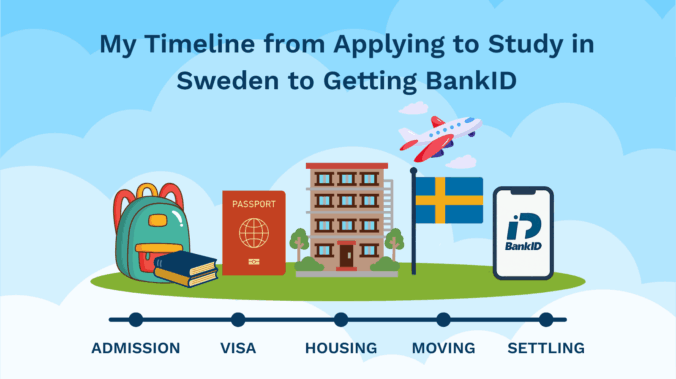
My Timeline from Applying to Study in Sweden to Getting Bank ID – By: Shakya

Moving abroad for studies is exciting, but it comes with a long checklist of tasks. When I applied to Uppsala University Campus Gotland, I had little idea how many steps were involved, from submitting my application to finally getting BankID (which is essential for life in Sweden). If you’re planning to study here or have just arrived, this timeline might help you understand what to expect. 

Application & Admission Phase 

  • Application Submission: 09 January 2025 

 The official deadline was January 15, and you can make changes to your application, like adding or removing programs, changing the ranking of your selected programs, and editing your personal details, until the deadline, even after submitting. 

  • Submitting Documents: 02 January 2025  

The official document deadline was 03 January 2025. After submitting your application, you still have a few more days to submit your documents. I had a few complications with mine, so I had to submit them at the last moment. Don’t let this happen to you! 

Results & Tuition 

  • Admission Results: 03 April 2025  

Note that the date of publication of results is different for Master’s programs and Bachelor’s programs. It was the 27th of March for Master’s programs this year. Make sure you keep your email notifications on because this is The Big Day! 

  • Paying the First Instalment of Tuition Fee: 16 April 2025  

If you are required to pay tuition fees, the payment confirmation is crucial for your residence permit application. Keep in mind that Migrationsverket takes a bit longer than usual to process applications during the summer vacations. I paid mine as early as possible to ensure I had enough time for my visa process. 

Visa Process

  • Applying for Visa: 02 May 2025  

The earlier you start, the better! 

  • Receiving the Email requesting to provide Biometrics: 08 May 2025  

Since my country didn’t have a Swedish Embassy, I had to visit the Swedish Embassy in India to provide biometrics. 

  • Providing Biometrics: 23 May 2025  

Fortunately, I didn’t have to face an interview. Booking an appointment was not required to provide biometrics, but it is necessary if you need to attend an interview. Also note that these requirements can vary depending on the embassy and your application year. 

Housing

  • Applying for Housing (UUHO): 15 May 2025 

 If you are required to pay tuition fees, you are guaranteed housing through the Uppsala University Housing Office (UUHO), which provides housing in both Uppsala and Visby. Make sure you pay your first instalment of tuition fee on time to get the advantage of this benefit. 

  • Housing Decision: 02 June 2025 

Visa Decision & Travel 

  • Visa Decision: 02 June 2025  

I was lucky to get my Visa in one month, but these processes can vary widely. It’s always a good idea to check the Migrationsverket website for the most up-to-date information on estimated timelines. 

  • Booking Flight Tickets: 03 June 2025 

I booked my flight seats as soon as my Visa was granted with excitement and to secure a better rate. 

  • Residence Permit Card Arrival at the Swedish Embassy in Delhi: 12 July 2025 
  • Collecting my RP Card at the Swedish Consulate in Sri Lanka: 23 July 2025 

I didn’t have to visit the Swedish Embassy in India to collect my RP card because they sent it directly to the Swedish Consulate in Sri Lanka. 

  • Arrival in Visby: 24–25 August 2025  

It was finally time for the move. I left Sri Lanka on the 24th of August and landed in Visby on the 25th. It was almost a 24-hour journey with 2 layovers. 

Settling in Sweden

  • Applying for Personal Number: 27 August 2025  

You can get a Swedish Personal Number if your program lasts for more than a year. An appointment was not needed to visit Skatterverket (The Swedish Tax Office) in Visby to apply for the personal number but booking one can make the process easier and more convenient. You can book an appointment through Skatterverket’s website. It’s recommended to do this as early as possible because the steps leading up to getting a Swedish BankID can take quite a long time. 

  • Receiving the Personal Number: 26 September 2025 
  • Applying for a Swedish ID Card: 02 October 2025  

You cannot apply for an ID without an appointment at Skatterverket and your personal number. 

  • Getting ID Card: 10 October 2025 

Banking & BankID 

  • Applying to ICA Bank: 03 October 2025  

ICA Bank is a very student-friendly bank, offering multiple benefits for students, especially when shopping at ICA grocery stores and Apotek Hjärtat pharmacies. Unfortunately, ICA Bank doesn’t have any physical branches and cannot issue BankID unless you already have one or are a Swedish citizen. Since BankID is required to register and use the app, you can still apply for a student account using your personal number on their website while waiting to get BankID from another bank. 

  • Getting an appointment with LF Gotland: 13 October 2025  

It is often said that your life in Sweden truly begins once you get BankID. BankID is the most essential and sometimes the only verification method for accessing many services in Sweden. It can be hectic waiting for a long time to get an appointment at a bank to get BankID. But I found LF Bank to be very quick in this process. 

  • The date of Appointment and Submitting Documents: 14 October 2025 
  • Getting Bank Account, BankID & Swish: 22 October 2025  

Finally, my life began in Sweden! 

  • ICA Bank Card Arrival: 24 October 2025 

The entire process sounds overwhelming. But planning and keeping track of deadlines makes it manageable. The key is to start early, especially with tuition payments and visa applications, because these steps unlock other essentials like housing and your residence permit. Once you arrive, focus on getting your personal number and ID card, as they are prerequisites for banking and BankID. Remember to check official sources always and stay flexible. With patience and preparation, settling into life in Sweden becomes a smooth and rewarding experience. 

Disclaimer: This blog is based on my personal experience as an international student at Uppsala University Campus Gotland. It is not a promotion or criticism of any brand or service mentioned. Timelines and processes may vary depending on your country, year of application, and individual circumstances. 

Good Luck with your journey to Sweden!